May 10
ChRIS CLÉiRIGhannouncements
Title: The Construal of Spatial Meaning
Subtitle: Windows into Conceptual Space
Series Title: Explorations in Language and Space
Publication Year: 2013
Publisher: Oxford University Press
http://www.oup.com/us
Book URL: http://ukcatalogue.oup.com/product/9780199641635.do
Editor: Carita Paradis
Editor: Jean Hudson
Editor: Ulf Magnusson
Hardback: ISBN: 9780199641635 Pages: 368 Price: U.K. £ 70.00
Abstract:
This book considers how language users express and understand literal and
metaphorical spatial meaning not only in language but also through gesture and
pointing. Researchers explore the ways in which theoretical developments in
language and cognition, new empirical techniques, and new computational
facilities have led to a greater understanding of the relationship between
physical space and mental space as expressed in human communication.
Apr 23
eldonUncategorized
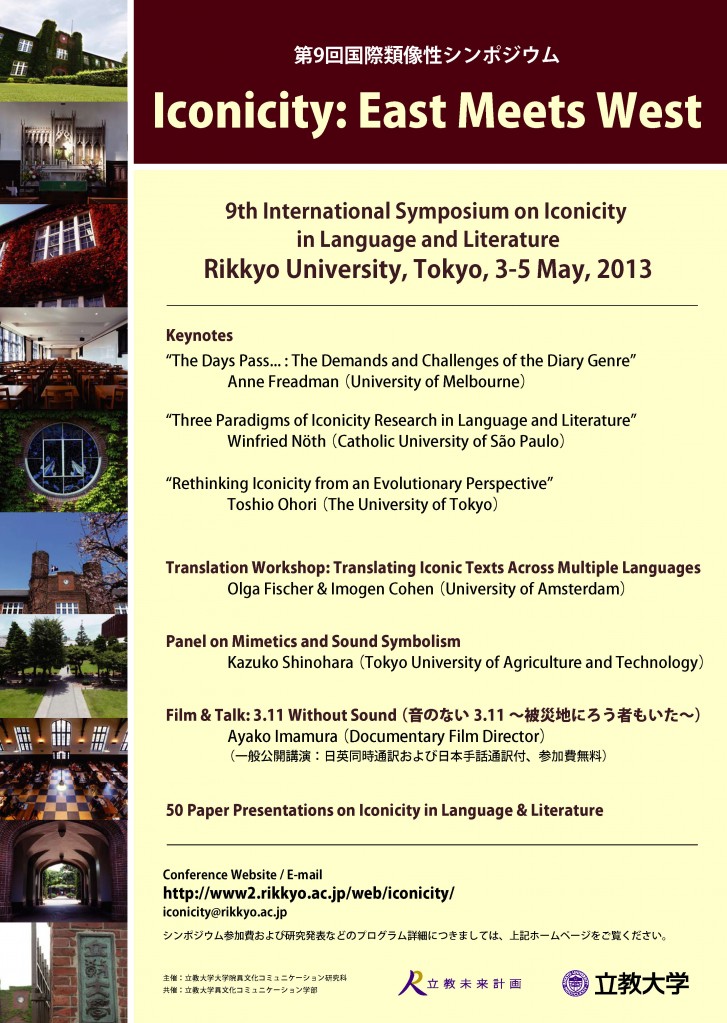
here’s a link to the conference website
there’s also a permanent link in the ‘conferences’ blogroll, way down on the right…
Apr 11
ChRIS CLÉiRIGhannouncements
Title: The Oxford Handbook of the History of Linguistics
Series Title: Oxford Handbooks in Linguistics
Publication Year: 2013
Publisher: Oxford University Press
http://www.oup.com/us
Book URL: http://ukcatalogue.oup.com/product/9780199585847.do
Editor: Keith Allan
Hardback: ISBN: 9780199585847 Pages: 952 Price: U.K. £ 95.00
Abstract:
In this outstanding book leading scholars from around the world examine the
history of linguistics from ancient origins to the present. They consider
every aspect of the field from language origins to neurolinguistics, explore
linguistic traditions in east and west, chronicle centuries of explanations
for language structures, meanings, and usage, and look at how it has been
practically applied.
The book is organized in six parts. The first looks at the origins of
language, the invention of writing, the nature of gesture, and sign languages.
Part II examines the history of the analysis and description of sound systems.
Part III considers the history of linguistics in China, Korea, Japan, India,
and the Middle East, as well as the history of the study of Semitic and
Afro-Asiatic. Part IV examines the history of grammar and morphology in the
west from the classical world to the present. Part V surveys the history of
lexicography semantics, pragmatics, and text and discourse studies. Part VI
looks at the history the application of linguistics in fields that include the
language classification; social and cultural theory; psychology and the brain
sciences; education and translation; computational science; and the
development of linguistic corpora. The book ends with a history of the
philosophy of linguistics.
The Oxford Handbook of the History of Linguistics makes a significant
contribution to the historiography of linguistics. It will also be a valuable
reference for scholars and students in linguists and related fields, including
philosophy and cognitive science.
Apr 09
ChRIS CLÉiRIGhannouncements
Title: Iconic Investigations
Series Title: Iconicity in Language and Literature 12
Publication Year: 2013
Publisher: John Benjamins
http://www.benjamins.com/
Book URL: http://benjamins.com/catalog/ill.12
Editor: Lars Elleström
Editor: Olga Fischer
Editor: Christina Ljungberg
Electronic: ISBN: 9789027272232 Pages: Price: U.S. $ 158.00
Electronic: ISBN: 9789027272232 Pages: Price: Europe EURO 105.00
Electronic: ISBN: 9789027272232 Pages: Price: U.K. £ 88.00
Hardback: ISBN: 9789027243485 Pages: Price: Europe EURO 111.30
Hardback: ISBN: 9789027243485 Pages: Price: U.K. £ 88.00
Hardback: ISBN: 9789027243485 Pages: Price: U.S. $ 158.00
Abstract:
The contributions to Iconic Investigations deal with linguistic or literary
aspects of language. While some studies analyze the cognitive structures of
language, others pay close attention to the sounds of spoken language and the
visual characteristics of written language. In addition this volume also
contains studies of media types such as music and visual images that are
integrated into the overall project to deepen the understanding of iconicity –
the creation of meaning by way of similarity relations. Iconicity is a
fundamental but relatively unexplored part of signification in language and
other media types. During the last decades, the study of iconicity has emerged
as a vital research area with far-reaching interdisciplinary scope and the
volume should be of interest for students and researchers interested in
scholarly fields such as semiotics, cognitive linguistics, conceptual metaphor
studies, poetry, intermediality, and multimodality.
Apr 06
ChRIS CLÉiRIGhannouncements
Full Title: Critical Approaches to Discourse Analysis across Disciplines
Short Title: CADAAD
Date: 01-Sep-2014 – 03-Sep-2014
Location: Budapest, Hungary
Contact Person: Tamás Eitler
Meeting Email: cadaad2014@gmail.com
Web Site: http://cadaad.net/cadaad_2014
Call Deadline: 01-Dec-2013
Meeting Description:
CADAAD conferences are intended to promote current directions and new developments in cross-disciplinary critical discourse research. The fifth CADAAD conference will take place in Budapest, 1-3 September 2014.
Reflecting the diversity of topics and approaches in critical discourse studies, the following distinguished guests have confirmed their participation as plenary speakers:
Professor Ruth Wodak (Lancaster University)
Professor Theo Van Leeuwen (University of Technology Sydney)
Professor Lilie Chouliaraki (London School of Economics)
Professor Andreas Musolff (University of East Anglia)
Professor Crispin Thurlow (University of Washington)
Call for Papers:
We welcome papers which, from a critical-analytical perspective, deal with contemporary social, scientific, political, economic, or professional discourses and genres. Possible topics include but are not limited to the following:
– (New) Media Discourse
– Party Political Discourse
– Advertising
– Discourses of War and Terrorism
– Discourses of Discrimination and Inequality
– Power, Ideology and Dominance in Institutional Discourse
– Identity in Discourse
– Education Discourses
– Environmental Discourses
– Health Communication
– Language and the Law
We especially welcome papers which re-examine existing frameworks for critical discourse research and/or which highlight and apply new methodologies sourced from anywhere across the humanities, social and cognitive sciences including but without being limited to the following fields:
– Sociolinguistics
– Multimodality
– Media and Mass Communication Studies
– Political Science
– Functional Linguistics
– Cognitive Linguistics
– Corpus Linguistics
– Pragmatics and Argumentation Theory
– Conversation and Discourse Analysis
– Ethnography of Communication
– Discursive Psychology
Papers will be allocated 20 minutes plus 10 minutes for questions. The language of the conference is English.
Abstracts of no more than 250 words including references should be sent as MS Word attachment tocadaad2014@gmail.com before 1 December 2013. Please include in the body of the email but not in the abstract itself (1) your name, (2) affiliation and (3) email address. Notifications of acceptance will be communicated by 1 March 2014.
A peer-reviewed collection of selected papers is planned to be published with an international publisher.
For more information, please visit http://cadaad.net/cadaad_2014. Should you have any questions, please contact us at cadaad2014@gmail.com.
Apr 02
ChRIS CLÉiRIGhannouncements
Title: Birdsong, Speech, And Language
Subtitle: Exploring the Evolution of Mind and Brain
Publication Year: 2013
Publisher: MIT Press
http://mitpress.mit.edu/
Book URL: http://mitpress.mit.edu/books/birdsong-speech-and-language-0
Editor: Johan J. Bolhuis
Editor: Martin Everaert
Hardback: ISBN: 9780262018609 Pages: 556 Price: U.S. $ 50.00
Abstract:
Scholars have long been captivated by the parallels between birdsong and human
speech and language. In this book, leading scholars draw on the latest
research to explore what birdsong can tell us about the biology of human
speech and language and the consequences for evolutionary biology. They
examine the cognitive and neural similarities between birdsong learning and
speech and language acquisition, considering vocal imitation, auditory
learning, an early vocalization phase (“babbling”), the structural properties
of birdsong and human language, and the striking similarities between the
neural organization of learning and vocal production in birdsong and human
speech.
After outlining the basic issues involved in the study of both language and
evolution, the contributors compare birdsong and language in terms of
acquisition, recursion, and core structural properties, and then examine the
neurobiology of song and speech, genomic factors, and the emergence and
evolution of language.
Contributors
Hermann Ackermann, Gabriël J. L. Beckers, Robert C. Berwick, Johan J. Bolhuis,
Noam Chomsky, Frank Eisner, Martin Everaert, Michale S. Fee, Olga Fehér, Simon
E. Fisher, W. Tecumseh Fitch, Jonathan B. Fritz, Sharon M. H. Gobes, Riny
Huijbregts, Erich Jarvis, Robert Lachlan, Ann Law, Michael A. Long, Gary F.
Marcus, Carolyn McGettigan, Daniel Mietchen, Richard Mooney, Sanne Moorman,
Kazuo Okanoya, Christophe Pallier, Irene M. Pepperberg, Jonathan F. Prather,
Franck Ramus, Eric Reuland, Constance Scharff, Sophie K. Scott, Neil Smith,
Ofer Tchernichovski, Carel ten Cate, Christopher K. Thompson, Frank Wijnen,
Moira Yip, Wolfram Ziegler, Willem Zuidema
Mar 31
eldonannouncements
This year’s ASFLA conference, to be held at the Melbourne Campus of the ACU in October, has its own page on Interstratal-Tension. You can find it in the ‘Conferences’ section of the Links on the sidebar, or the SFL-related links too..
Meantime, here us a direct link to the page devoted to this year’s local SFL gathering. More updates as they come to hand – and don’t forget that submission of abstracts closes on April 12th. See the flyer for more details.
Mar 22
ChRIS CLÉiRIGhannouncements
Title: Discourse Analysis and Human and Social Sciences
Publication Year: 2013
Publisher: Peter Lang AG
http://www.peterlang.com
Book URL: http://www.peterlang.com/?431241
Editor: Simone Bonnafous
Editor: Malika Temmar
Paperback: ISBN: 9783034312417 Pages: 177 Price: U.S. $ 63.95
Paperback: ISBN: 9783034312417 Pages: 177 Price: U.K. £ 39.00
Paperback: ISBN: 9783034312417 Pages: 177 Price: Europe EURO 49.00
Abstract:
What is the relationship between discourse analysis and its more recent
companion disciplines such as sociology, political science and information and
communication sciences, at their point of convergence between the symbolic and
the social? How are relationships evolving between discourse analysis and
disciplines like the literary studies, psychoanalysis and philosophy, which
have been the constant companions of linguistics as these emerged and
developed? What is the place and role of discourse analysis in Europe? These
are some of the themes dealt with in this book. A team effort on the part of
Centre d’Etude des Discours, Images, Texte, Ecrits, Communication (Céditec EA
3119), it aims not to present another view of the history and concepts of
discourse analysis, but to encourage thinking and debate on interdisciplinary
practices.
Mar 14
ChRIS CLÉiRIGhUncategorized
Research published today in the Proceedings of the National Academy of Sciences shows patterns from these Facebook preferences can provide surprisingly accurate estimates of your race, age, IQ, sexuality and other personal information.
The researchers developed an algorithm which uses Facebook likes – which are publicly available unless a user chooses stronger privacy settings – to create personality profiles, potentially revealing a user’s intimate details.
These mathematical models proved 88 per cent accurate for differentiating males from females and 95 per cent accurate distinguishing African-Americans from whites.
The algorithms were also able to extrapolate information such as sexual orientation, whether the user was a substance abuser, or even whether their parents had separated.
This data can be used for advertising and marketing, but it also could make users cringe because of the amount of personal data revealed, the researchers said.
“It’s very easy to click the ‘like’ button, it’s seductive,” said David Stillwell, a psychometrics researcher and co-author of the study with colleagues from the University of Cambridgeand Microsoft Research.
“But you don’t realise that years later all those likes are building up against you.”
Stillwell says that while Facebook data was used in this study, similar profiles could be produced using other digital data including web searches, emails and mobile phone activity.
“You can come to the same conclusions with many forms of these digital data,” he says.
The study examined 8,000 US Facebook users, who volunteered their likes, demographic profiles and psychometric testing results.
While some of the patterns appeared obvious – Democrats like the White House while Republicans liked George W. Bush – others were less direct.
Extroverts liked actress and singer Jennifer Lopez, while introverts gravitated toward the film The Dark Knight. Those determined to be “liberal and artistic” liked singer Leonard Cohen and writer Oscar Wilde, while conservatives preferred Nascar racing and the film Monster-in-Law.
The predictions relied to a large degree on inference, by aggregating huge amounts of data: those predicted to be homosexual were tagged as such not because they clicked on sites about gay marriage, but because of their preferences in music and TV shows, for example.
Christians and Muslims were correctly classified in 82 per cent of cases, and good prediction accuracy was achieved for relationship status and substance abuse, between 65 and 73 per cent.
People with high IQs more frequently liked The Colbert Report television show and films including The Godfatherand To Kill a Mockingbird.Those with lower IQs preferred Harley Davidsons and Bret Michaels of the rock band Poison.
http://www.abc.net.au/science/articles/2013/03/12/3713455.htm
Older Entries Newer Entries
 RSS
RSS
Recent Comments