Sep 29
ChRIS CLÉiRIGhstratification
Halliday & Matthiessen (1999: 613-4):
[To transcend the limits of protolanguage] you need a semiotic of a different kind, one that allows for a purely abstract level of representation “in between” the two faces of the sign. To put this another way, the sign has to be deconstructed so that, instead of content interfacing directly with expression, the relationship is mediated by a systematic organisation of form (a lexicogrammar). In other words, the semiotic has to become stratified.
That is, what is “in between” the two faces of a sign is a lexicogrammar.
Sep 27
ChRIS CLÉiRIGhgeneral observations
Gravitation, or gravity, is a natural phenomenon by which physical bodies attract with a force proportional to their mass. In everyday life, gravitation is most familiar as the agent that gives weight to objects with mass and causes them to fall to the ground when dropped.
Sep 25
ChRIS CLÉiRIGheducation and academia, general observations
The Asch conformity experiments were a series of studies published in the 1950s that demonstrated the power of conformity in groups. These are also known as the Asch Paradigm.
Experiments led by Solomon Asch of Swarthmore College asked groups of students to participate in “vision tests”. In reality, all but one of the participants were confederates of the experimenter, and the study was really about how the remaining student would react to the confederates’ behaviour.
In the basic Asch paradigm, the participants — the real subjects and the confederates — were all seated in a classroom. They were asked a variety of questions about the lines such as how long is A, compare the length of A to an everyday object, which line was longer than the other, which lines were the same length, etc. The group was told to announce their answers to each question out loud. The confederates always provided their answers before the study participant, and always gave the same answer as each other. They answered a few questions correctly but eventually began providing incorrect responses.
In a control group, with no pressure to conform to an erroneous view, only one subject out of 35 ever gave an incorrect answer. Solomon Asch hypothesized that the majority of people would not conform to something obviously wrong; however, when surrounded by individuals all voicing an incorrect answer, participants provided incorrect responses on a high proportion of the questions (32%). Seventy-five percent of the participants gave an incorrect answer to at least one question.
Variations of the basic paradigm tested how many cohorts were necessary to induce conformity, examining the influence of just one cohort and as many as fifteen. Results indicate that one cohort has virtually no influence and two cohorts have only a small influence. When three or more cohorts are present, the tendency to conform is relatively stable.
The unanimity of the confederates has also been varied. When the confederates are not unanimous in their judgment, even if only one confederate voices a different opinion, participants are much more likely to resist the urge to conform than when the confederates all agree. This finding illuminates the power that even a small dissenting minority can have. Interestingly, this finding holds whether or not the dissenting confederate gives the correct answer. As long as the dissenting confederate gives an answer that is different from the majority, participants are more likely to give the correct answer.
Aug 25
ChRIS CLÉiRIGhgeneral observations
A basic explanation of the idea that some sounds are inherently linked to particular meanings that are common across languages as well as common to a range of animal species.
— John J. Ohala, professor emeritus of linguistics, University of California, Berkeley, USA.
Click here.
Jul 13
eldonappraisal, pragmatics, semantics
or, why the term ‘commitment’ is already lexically ‘full’ for most linguists who’ve been hit with the psychological stick.
here, below, is a table excerpted from an older article discussing the advances made in the study of affect and emotive v. emotional language at the time: the source is at the top, so no need to reference.[click on the pic for a better image]
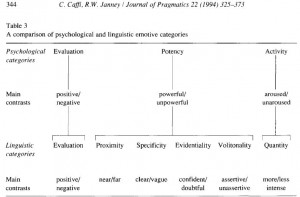
the disparate affectations of linguistic labels
it’s notable that for most linguists in the pragmatics tradition (claiming the prague school amongst their antecedents) there has existed a separation between specificity and evidentiality.
the most recent use of the term ‘commitment’ by students of SFL seems more aligned with traditional pragmaticists’ notions of specificity, while for these pragmatic types, ‘commitment’ is a term that is a function of markers of evidentiality, i.e. personal commitment to a position.
while a degree of specificity in language use might also function to signal an individual writer’s degree of commitment to a proposition, my own position on the matter of evidentiality is that it tends to focus attention on the intent of the individual, rather than the social construction of interpersonal relationship (given that both experiential as well as interpersonal meanings are entailed in discourse semantic constructions of such co-positioning) [i feel a sense of irony as i write this].
while many linguists are now taking up the idea that individual psychological ‘processes’ need to be not only factored in but accounted for in any analysis of language – and thus terms which suggest individual psychological focus may be part of a trend – the fact that the use of the term ‘commitment’ seems to straddle two distinctions in traditional discourse analytic approaches may render it immiscible with them.
As is well known, the main linguistic means of commitment in the epistemic modality are Urmson’s (1952) parenthetical verbs, and modal adverbs like ‘probably’, which modify the ‘claim to truth’ of an
assertion. These are called ‘evidentials’ in another tradition. If commitment is defined as a sign of subscription (‘neustic’ in Hare’s terms) (cf. Hare, 1970; Lyons, 1977), then involvement, it seems, could be defined as the emotive subscription to the utterance.
( Caffi&Janney:348)
Jul 01
ChRIS CLÉiRIGhsuitable quotations
Halliday (1987: 136):
From now on, the human sciences have to assume at least an equal responsibility in establishing the foundations of knowledge. Their coat-tailing days are over. But if so, our practitioners will surely have to learn to behave responsibly, instead of squandering themselves in the wasteful struggle for originality in which everyone else must be deconstructed so that each can leave his (or her) mark. We have to build on our predecessors and move forward, instead of constantly staying behind where they were in order to trample them underfoot.
Older Entries Newer Entries
 RSS
RSS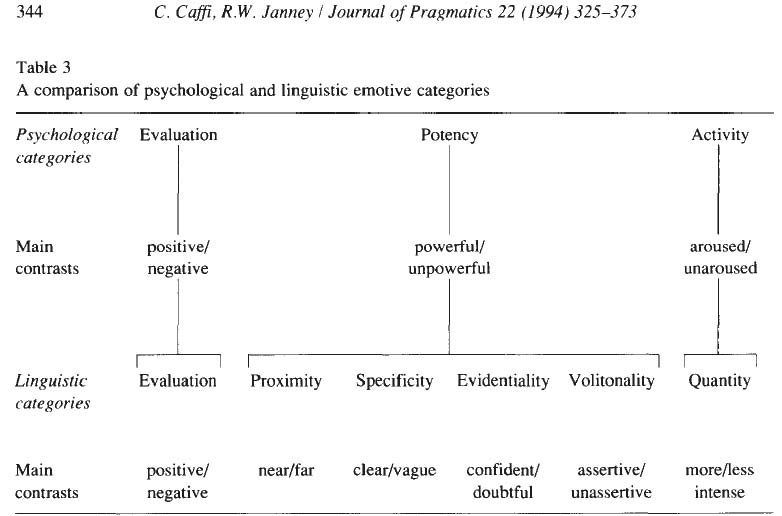

Recent Comments