May 06
ChRIS CLÉiRIGhannouncements
Title: Language, Culture, and Mind
Subtitle: Natural Constructions and Social Kinds
Publication Year: 2014
Publisher: Cambridge University Press
Book URL: http://www.cambridge.org/us/academic/subjects/languages-linguistics/cognitive-linguistics/language-culture-and-mind-natural-constructions-and-social-kinds?format=PB
Author: Paul Kockelman
Paperback: ISBN: 9781107689022 Pages: Price: U.K. £ 23.99
Paperback: ISBN: 9781107689022 Pages: Price: U.S. $ 37.99
Abstract:
Editor’s Note: This is a new paperback edition of a previously announced book.
Based on fieldwork carried out in a Mayan village in Guatemala, this book examines local understandings of mind through the lens of language and culture. It focuses on a variety of grammatical structures and discursive practices through which mental states are encoded and social relations are expressed: inalienable possessions, such as body parts and kinship terms; interjections, such as ‘ouch’ and ‘yuck’; complement-taking predicates, such as ‘believe’ and ‘desire’; and grammatical categories such as mood, status and evidentiality. And, more generally, it develops a theoretical framework through which both community-specific and human-general features of mind may be contrasted and compared. It will be of interest to researchers and students working within the disciplines of anthropology, linguistics, psychology, and philosophy.
1. Language, culture, mind: emblems of the status human;
2. Inalienable possessions: what hearts, mothers, and shadows have in common;
3. Interclausal relations: how to enclose a mind by disclosing a sign;
4. Myths about time and theories of mind: why the moon married the sun;
5. Other minds and possible worlds: when psychological depth is dialogical breadth;
6. Interjections: why the center of emotion is at the edge of language;
7. Conclusion: natural constructions and social kinds.
May 06
ChRIS CLÉiRIGhannouncements
Title: Meaning, Discourse and Society
Publication Year: 2014
Publisher: Cambridge University Press
Book URL: http://www.cambridge.org/us/academic/subjects/languages-linguistics/discourse-analysis/meaning-discourse-and-society?format=PB
Author: Wolfgang Teubert
Paperback: ISBN: 9781107660502 Pages: Price: U.K. £ 24.99
Paperback: ISBN: 9781107660502 Pages: Price: U.S. $ 38.99
Abstract:
Editor’s Note: This is a new paperback edition of a previously announced book.
Meaning, Discourse and Society investigates the construction of reality within discourse. When people talk about things such as language, the mind, globalisation or weeds, they are less discussing the outside world than objects they have created collaboratively by talking about them. Wolfgang Teubert shows that meaning cannot be found in mental concepts or neural activity, as implied by the cognitive sciences. He argues instead that meaning is negotiated and knowledge is created by symbolic interaction, thus taking language as a social, rather than a mental, phenomenon. Discourses, Teubert contends, can be viewed as collective minds, enabling the members of discourse communities to make sense of themselves and of the world around them. By taking an active stance in constructing the reality they share, people thus can take part in moulding the world in accordance with their perceived needs.
Introduction; Part I. Meaning, the Mind and the Brain:
1. The cognitive turn;
2. The long history of mind linguistics;
3. What do we know about mental concepts?;
4. Morphing theoretical sémes into ‘real’ concepts;
5. From mental representations to conceptual ontologies;
6. What is meaning?;
7. Where should we look for meaning?;
Part II. Discourse and Society:
8. Language as discourse;
9. Society presupposes language, and language presupposes society;
10. A closer look at oral societies;
11. Differences between oral and literate societies;
12. Empirical linguistics deals only with recorded language;
13. Meaning, knowledge and the construction of reality;
14. The language of the scientific experimental report;
15. Diachronicity, intertextuality and hermeneutics;
16. Meaning and the interpretation of a haiku;
Conclusion.
Apr 30
ChRIS CLÉiRIGhannouncements
Title: The Language Hoax
Subtitle: Why the World Looks the Same in Any Language
Publication Year: 2014
Publisher: Oxford University Press
http://www.oup.com/us
Book URL: http://global.oup.com/academic/product/the-language-hoax-9780199361588
Author: John H. McWhorter
Hardback: ISBN: 9780199361588 Pages: 208 Price: U.S. $ 19.95
Abstract:
Japanese has a term that covers both green and blue. Russian has separate terms for dark and light blue. Does this mean that Russians perceive these colors differently from Japanese people? Does language control and limit the way we think?
This short, opinionated book addresses the Sapir-Whorf hypothesis, which argues that the language we speak shapes the way we perceive the world. Linguist John McWhorter argues that while this idea is mesmerizing, it is plainly wrong. It is language that reflects culture and worldview, not the other way around. The fact that a language has only one word for eat, drink, and smoke doesn’t mean its speakers don’t process the difference between food and beverage, and those who use the same word for blue and green perceive those two colors just as vividly as others do.
McWhorter shows not only how the idea of language as a lens fails but also why we want so badly to believe it: we’re eager to celebrate diversity by acknowledging the intelligence of peoples who may not think like we do. Though well-intentioned, our belief in this idea poses an obstacle to a better understanding of human nature and even trivializes the people we seek to celebrate. The reality — that all humans think alike — provides another, better way for us to acknowledge the intelligence of all peoples.
Apr 12
ChRIS CLÉiRIGhannouncements
Title: Origins of Language
Subtitle: A Slim Guide
Publication Year: 2014
Publisher: Oxford University Press
http://www.oup.com/us
Book URL: http://ukcatalogue.oup.com/product/9780198701668.do
Author: James R. Hurford
Hardback: ISBN: 9780198701668 Pages: 192 Price: U.K. £ 40.00
Paperback: ISBN: 9780198701880 Pages: 192 Price: U.K. £ 14.99
Abstract:
Jim Hurford looks at the very varied aspects of this evolution, covering human
prehistory; the relation between instinct and learning; biology and culture;
trust, altruism, and cooperation; animal thought; human and non-human vocal
anatomy; the meanings and forms of the first words; and the growth of complex
systems of grammar and pronunciation. Written by an internationally recognized
expert in the field, it draws on a number of disciplines besides linguistics,
including philosophy, neuroscience, genetics, and animal behaviour, and will
appeal to a wide range of readers interested in language origins and
evolution.
Apr 10
ChRIS CLÉiRIGhbook review
AUTHOR: Monika Bednarek
AUTHOR: Helen Caple
TITLE: News Discourse
SERIES TITLE: Bloomsbury Discourse
PUBLISHER: Bloomsbury Publishing (formerly The Continuum International Publishing Group)
YEAR: 2012
REVIEWER: Chrystie Myketiak, Queen Mary, University of London
SUMMARY
“News Discourse,” by Monika Bednarek and Helen Caple, is part of the
longstanding Bloomsbury Discourse Series edited by Ken Hyland that provides
students and researchers with introductions to core topics in discourse
studies. This particular volume consists of nine chapters plus two appendices
that discuss news discourse as it pertains to language and image in news
construction. In addition to providing an introduction to the topic, with a
non-exclusive focus on newspapers, the authors also provide frameworks for
their own approaches to analysing language and image in soft and hard news
stories, drawing from examples across news modalities and forms. The book’s
final chapter is a case study of online video news reporting about the death
of Osama Bin Laden that makes use of material discussed in the book’s
discursive and methodological chapters. Roughly speaking, Chapters 1, 2, 4 and
5 could be seen as providing introductions to news discourse, while Chapters
3, 6, 7, 8, and 9 could be treated as methodological.
Each chapter in the text begins with an introductory paragraph, a list of
objectives, and a section that operationalizes the main terms and concepts
discussed in the chapter. Similarly uniform is the list of suggested readings
at the end of each chapter. The directions for further reading provide
viewpoints both complementary and alternative to the ones presented in the
chapter. The authors also provide a concise summary of each reading to aid
readers.
Chapter 1 operationalizes ‘news discourse’, stating that it is necessary to do
so in ways that prioritise each of the two words in the term. The authors make
clear that for their purposes discourse is multisemiotic and includes language
and image in news construction. They differentiate themselves from those who
focus exclusively on language as well as those who observe discourse as a
reflection of news, rather than as an active construction of it. The chapter
introduces readers to the various types of news discourse that are discussed
over the course of the volume (e.g., print, online, television, radio,
podcasts, etc.) and provides an overview for various approaches to its
analysis. Bednarek and Caple provide descriptions of eight distinct linguistic
approaches to news discourse and another four approaches that are within the
domain of media/journalism and communications. The chapter closes with a
summary and discussion of the book’s structure.
Chapter 2 begins with five objectives that are squarely placed in the ‘how’
camp: how news develops, and is produced, consumed, regulated, and financed.
The authors argue that understanding these five topics is necessary in order
for researchers to contextualise their data analysis. They describe the
communicative context of news as a complex triangle between news discourse,
producers, and audience with energy transferring in all directions. Bednarek
and Caple then provide a sociohistorical context for news discourse,
discussing the development of the print news media in the UK, as well as its
digitization, financing, and regulation.
The topic of news values, as defined by Bell (1991:155), is introduced as the
focus of Chapter 3. Although Bednarek and Caple also provide four other
definitions of news values, they make clear that “what these different
definitions have in common, however, is that news values are said to determine
what makes something newsworthy — worthy of being news” (p. 40). They further
draw on Bell (1991) in their categorisation of news values (Bell’s are in
parentheses): news writing objectives (values in news text), news cycle/market
factors (values in news process), and news values (values in news actors and
events). From there the authors develop a news values summary, which includes
elements similar to other such discussions (e.g., Cotter 2010; O’Neill and
Harcup 2009; Richardson 2007). What follows from this is a short discussion of
whether news values are cognitively or discursively conceptualised. Bednarek
and Caple then consider news values and linguistic devices. This discussion
includes but is not limited to evaluative language, intensification and
quantification, word combinations, story structure, and first-person plural
pronouns. From there the authors turn to news values and image, using some of
the same subthemes as listed above but also incorporating aesthetic elements.
The chapter concludes with a return to their original news value summary. At
this point they provide and discuss examples of news stories as they pertain
to each news value in order to discuss how news values are construed in
discourse.
News discourse as a language variety is the focus of Chapter 4. Bednarek and
Caple outline key lexical and syntactic features that distinguish news
discourse from other linguistic varieties. They discuss the prevalence of
nouns, subsequent nominalisations, and prepositional phrases in print news.
The authors suggest that noun phrases work to evaluate and label news actors
and sources. With respect to verbs, the authors provide data from a corpus of
UK news discourse, arguing that ‘will/would’ are key verbs, and that finite
verbs rarely occur in the passive voice. They argue that time specification is
the most common type of adverbial and that linking adverbials are rare. This
discussion leads into the topic of the structure of the news story, which they
posit can be separated into three parts in most print genres: headline,
intro/lead, and body/lead development. The topic of ‘headlinese’ is discussed
in some detail, including features, verbs, and examples of headlines. Online,
radio, and television news headlines are discussed in the last section of the
chapter.
Chapter 5 shifts attention to still and moving images in the news, including
which images are used and their purpose/s in news coverage. The communicative
function of news images is discussed and is divided into a number of
categories: illustration, evidence, sensation, icon, evaluation, and
aesthetic. The relationship between text and image is discussed, including
image and caption relations, image and headline relations, and image and body
text relations. The final section discusses text and image relations in
sequenced images.
In Chapter 6, the authors provide the first of two frameworks for analysing
language and image in news discourse: a linguistic framework for analysing the
role of language in news stories. Bednarek and Caple discuss various
parameters of their framework: un/importance, in/comprehensibility,
im/possibility and in/ability, un/necessity, emotivity, in/authenticity,
reliability, un/expectedness, evidentiality, and mental state. The chapter
ends with a discussion of other issues for consideration, focusing on
evaluation of the sentiment behind the text: namely, whether or not the
journalist is expressing an opinion, what (if anything) is being evaluated,
the degree of evaluation, and the purpose of evaluation.
Chapter 7 complements the previous chapter, providing a framework for
analysing image composition. Here the authors draw on Caple’s training and
career as a press photographer to claim that news image composition is based
on balance and symmetry. They develop a framework for analysing balance and
composition in news discourse, which includes: image frame, elements, and
visual unit of information. The authors also discuss a number of different
patterns in photographs, the importance of aesthetics, and problematic or
‘ugly’ images.
Chapter 8 applies the frameworks of the previous two chapters (evaluation in
language and image composition) in analysing the topic of the stand-alone
print news story. The authors explain the concept of the stand-alone story and
provide a combination of qualitative and quantitative analysis of stand-alones
in the Sydney Morning Herald. The quantitative analysis focuses on composition
and evaluation while the differences between soft and hard news stories are
discussed primarily using qualitative research. Their argument is that images
in this format are of good composition and a high technical standard, and that
the headlines associated with the images tend towards playfulness (e.g.,
through the use of puns, allegories, etc.). They found this to be the case
with both hard and soft stand-alone stories, and assert that this could be
considered inappropriate for some hard news stories, which tend to focus on
material events that affect people’s lives.
The final chapter, Chapter 9, is a case study that focuses on Osama Bin
Laden’s death. As with Chapter 8, the emphasis here is on applying their
frameworks and concepts to the study of news discourse. They discuss the
reason for selecting this example over other global news events during the
same period (2010/2011). They then apply earlier discussed frameworks and
concepts from Chapters 3-5 to their analysis of two video clips approximately
one minute in length from the websites of public news broadcasters in
Australia and the United Kingdom.
The volume also contains two appendices and an index.
EVALUATION
“News Discourse” is a volume on an interesting subject that merges two
important and interconnected topics within news discourse: text and image.
Bednarek and Caple introduce readers to the field while also providing
methodological frameworks to aid in data analysis. The book fills an important
gap in the existing literature in that it considers news discourse in a
variety of mediums, and gives equal weighting to image and text. The volume
will be particularly useful to students or those moving into this research
field as it provides both an overview to the topic and a toolkit for analysing
news.
This is a book that takes on a great deal: it is an introductory text, a
methodological guide, and it covers both image and language. The breadth of
material ensures that the book will be useful to students and researchers of
news texts and images across a range of disciplines. However, as a result of
the ambitious range of approaches and key studies discussed alongside their
own analyses, there are sections where the exposition seems too brief. This is
especially true in some of the chapters emphasising methodological frameworks,
where a topic is introduced and discussed for a single paragraph before the
authors move onto the next theme.
The short sections and subsections that move between distinct ideas allow
Bednarek and Caple to cover much terrain but further elaboration of some of
their themes (and subthemes) and frameworks might have been helpful to
readers. For example, their discussion of cognitive and discursive approaches
to news values might have benefited from further elaboration and/or clarity.
The authors state (p. 44) that the cognitive perspective holds the position
that news values originate in mental assumptions and categorisation, but this
is not taken any further (i.e., how do these assumptions and categories come
into being?). Similarly, “from a discursive perspective […] newsworthiness
is construed through discourse (both language and image)” (p. 44). For readers
not steeped in the discussion already, these definitions provide little
clarification of cognitive and discursive approaches to news values.
Chapters 4 and 7 stand out as providing excellent mixtures of
concepts/frameworks and supporting data. These two chapters will be of
particular interest to linguists researching or teaching in the area as well
as linguistics students. Chapter 4, which focuses on news discourse as a
language variety, includes discussions of linguistic features specific to news
discourse and their functions. Bednarek and Caple provide a broad set of
examples to illustrate their argument as well as a framework to use in
approaching news text. Chapter 7 focuses on composition, balance, and
aesthetics in image composition, which is an important but under-examined area
within the study of news discourse. The authors’ introduction to image
composition and analysis is accessible and provides a wide range of examples
of images to support their frameworks.
It is impressive that the authors balance their treatment of text with image,
and concept with framework. However, the way that this is sequenced in the
volume is somewhat unclear. Although there is a section of the introduction
dedicated to the ‘[s]tructure and summary of the book’ (p. 14-17), it does
not include how the chapters fit together, why the book is structured as it
is, or any clear reason for their sequencing. It may have been helpful to
readers had the authors explained how the chapters follow from each other, and
why the authors favoured this sequence and division of material as opposed to
other equally valid strategies.
One issue that it might have been interesting for Bednarek and Caple explore
is whether text and image must be analysed using separate frameworks, and to
be explicit about where independent analysis joins up again. The authors
structure the discussion of text and image quite separately in earlier
chapters but analyse the two together in the latter chapters. Chapter 8 uses
examples to examine language and image in soft and hard news stories and their
case study in Chapter 9 looks at an online video story (thus combining image
and language). However, the frameworks that they provided earlier in the book
treat image and text rather separately.
“News Discourse” is a valuable addition to the Bloomsbury Discourse series; it
covers an interesting topic in a novel way that will be of interest to a wide
readership. More importantly, the volume does so in a way that is timely both
in the modalities under consideration and the data used. Bednarek and Caple’s
book incorporates an extensive range of material and examines the crucial
interplay of text and image in contemporary news discourse. The book will be
useful to researchers and students interested in linguistic, media, or
discursive approaches to analysing news texts and images.
REFERENCES
Bell, A. 1991. The Language of News Media. Oxford: Blackwell.
Cotter, C. 2010. News Talk. Cambridge: Cambridge University Press.
O’Neill, D. and Harcup, T. 2009. “News Values and Selectivity,” in K. Wahl
Jorgensen and T. Hanitzsch (eds.), The Handbook of Journalism Studies. New
York: Routledge, pp.161-174.
Richardson, J.E. 2007. Analysing Newspapers: An Approach from Critical
Discourse Analysis. Houndmills: Palgrave Macmillan.
ABOUT THE REVIEWER
Chrystie Myketiak is a postdoctoral fellow at Queen Mary, University of London
where she works on CHI+MED, a project at the intersection of human-computer
interaction and medical safety. Her research combines media, health, and
discourse in a variety of ways, including: medical errors in incident reports;
the construction of blame in news about medical errors; and online sex talk.
She holds a PhD in Computer Science (Interaction, Media, and Communication)
and Linguistics from the University of London.
Mar 24
eldonannouncements asfla, conferences
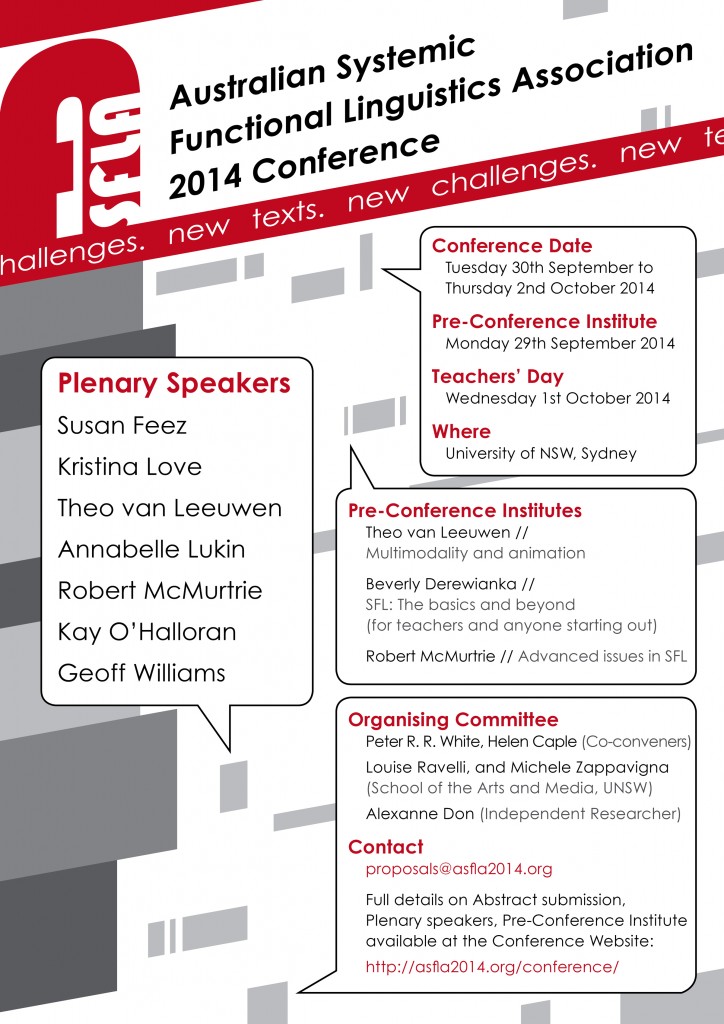
The conveners of the 2014 Australian Functional Linguistics Association annual conference have published their flyer for the upcoming conference.
Check it out and download a PDF version to print out and attach to your corridor wall!
Mar 18
ChRIS CLÉiRIGhbook review
AUTHOR: Alexandra Jaffe
TITLE: Stance
SUBTITLE: Sociolinguistic Perspectives
SERIES TITLE: Oxford Studies in Sociolinguistics
PUBLISHER: Oxford University Press
YEAR: 2012
REVIEWER: Simone C. Bacchini, British Library
SUMMARY
“Stance: Sociolinguistic Perspectives” is, in the words of its editor, ‘a
sociolinguistic exploration of one of the fundamental properties of
communication: stancetaking’ (3). In its ten chapters, the contributors to
this volume offer explorations of some of the ways in which speakers’
positionality is linguistically encoded through various lexicogrammatical and
discursive means. Although, for the most part, the essays contained in this
volume refer to contemporary English language examples, the collection also
contains cases of non-English contexts and, in one of these, a
non-contemporary situation.
This volume refers to encodings of speakers’ positionality as ‘stance’ and
‘stancetaking’. As Jaffe explains, stancetaking refers to ‘taking up a
position with respect to the form and content of one’s utterance’ (3). Jaffe
clearly acknowledges that the linguistic encoding of stance is not new.
However, she rightly points out that each act of stancetaking is, by its very
nature, both socially situated and dialogic: it occurs in a specific social
context, which contributes to its shape; and it responds, directly or
indirectly, to other possible stances a speaker might take in ways that are
socially and interactionally relevant. With time, repeated acts of
stancetaking can become indexical, at a higher level, of things such as
femininity, for example. It is against these backdrops of indexicality that
further stancetaking then takes place.
The main way in which the studies presented in this volume differ from
previous ones is that their perspective is clearly sociolinguistic. What this
means is that here, the approaches taken are ‘explicitly socially grounded’
(Coupland 1991: 99). As Jaffe explains, a sociolinguistic approach to stance
and stancetaking is interested in the ways in which speakers ‘draw upon
sociolinguistic resources and repertoires to signal positionality’ (10). What
is meant by ‘sociolinguistic resources’ is ‘forms of variation that have
established social indexicalities’ (10). All the studies in this volume
successfully deal with a number of such indexicalities: authoritative speech,
rationality vs. irrationality, moral irony, and elitism, to name but a few.
This collection of essays opens with an exhaustive introduction (Chapter One)
by the volume’s editor, Alexandra Jaffe. In it, the aim of the work is clearly
stated: ‘to map the sociolinguistics of stance, bringing together analyses
that allow […] to explore both what the study of stance has to offer
sociolinguistic theory, and to define the territory occupied by
sociolinguistic approaches to stance’ (3). The extent to which it is
successful will be addressed later. As Jaffe makes clear, the goal of her
introduction is not to provide a general overview of research on stance, but
rather, more modestly, to ‘identify dimensions of stance research that are
particularly salient for sociolinguistics, and to situate the sociolinguistic
focus on stance in relation to related concepts and currents of analysis
within sociolinguistics and linguistic anthropology’ (4).
Jaffe provides the reader with a useful introduction to the study of stance by
first defining the object of enquiry and then by clearly explaining why a
sociolinguistic approach, as opposed to other available approaches, is a
productive one is shedding light on the various choices speakers and writers
make when they encode positionality within a text.
Chapter Two (Stance, Style, and the Linguistic Individual), by Barbara
Johnstone, is a discourse analytical study of one particular individual’s
textual production (i.e. including both talk and writing) across a variety of
genres and over a number of years. The analysis also makes use of biographical
and historical data on the sociolinguistic and ideological contexts in which
this well-known U.S political figure, Barbara Jordan, operated, and how, in
turn, her linguistically encoded examples of stancetaking became indexical,
through repetition, of this particular individual’s identity. For example,
Johnstone points how the late U.S. politician established personal authority
by repeated acts of linguistic epistemic and interactional stancetaking. Both
in face-to-face interviews and in public speaking, Jordan would present and
project moral and epistemological authority by highlighting (and thus drawing
attention to) her knowledgeability, the power of intellect, her adherence to
principle and her thoughtfulness. Explicit markers of evidentiality, encoded
linguistically through markers such as ‘I think’, ‘in my opinion’ and phrases
like ‘this may be too much of a generalization’, are convincingly shown by
Johnstone to contribute to the establishment of Jordan as a (in this instance)
thoughtful individual.
Chapter Three (Stance in a Colonial Encounter: How Mr. Taylor Lost His
Footing), by Judith T. Irvine, makes use of Goffman’s (1981) notions of
‘faultables’ and of ‘audience’ to better understand the concept of ‘stance’.
She does this by offering an analysis of archival material, in this case,
letters held in the archive of the Church Missionary Society (CMS) from their
nineteenth-century missions in West Africa. The letters concern a violent
dispute among missionaries, which resulted in the corpus of letters between
the missionaries, their locally-based bishop, and the church authorities in
London. Irvine clearly and convincingly shows how – through stancetaking – the
different social actors involved (i.e. the missionaries and their local
bishops) positioned themselves vis-à-vis the ‘faultable’ actions of one
particular missionary. The author points out that often an excessive emphasis
on speaker intentionality and agency in stancetaking obscures how dispreferred
stances can be imposed on speakers by others. These stances, in turn, are
shaped and influenced by the various social and power structures in which such
speakers operate.
In Chapter Four, Janet McIntosh takes an ethnographic approach to examine the
narratives of white Kenyans. She shows how, through stance choices, they
ostensibly establish distance between their rational, Western selves and the
superstitious, irrational belief system of black Kenyans. However, McIntosh
shows that, in closer inspections, these white Kenyans’ belief system is less
coherent and more porous than they would like their listener to believe. In
fact, their cumulative stance choices reveal a degree of anxiety about the
possibility of cultural assimilation and suggest that these choices might
serve to perform a preferred identity.
Chapter Five, by Robin Shoaps, aims, in the author’s words, to ‘demonstrate
the necessity of ethnographic research for the study of resources for indirect
stancetaking and how they are deployed in naturally occurring speech
situations’ (92). Shoaps’s is the first study in the collection which looks at
a language other than English; she examines, Sakalputek, a Mayan language
spoken in Guatemala. The author looks at constructions that encode what she
terms ‘moral irony’ which, superficially, resemble ironic constructions in
English. These constructions, she argues, provide an important resource in
Sakalputek for indirect stancetaking. Shoaps argues that in these
constructions, ‘moral irony’ is ‘modal’ ‘not only because the construction
makes use of modal particles, but because, semiotically, it projects a realm
of possible actions and a possible division between the speaker or animator
and principal or agent who takes responsibility for or is committed to the
hypothetical stance or action’ (112-113). It is ‘ironic’ because – following
Goffman – the principal ‘who is committed to the possible stance is distinct
from the animator who, in the moment of speaking, rejects the stance or
action’ (113). For example, in an encounter where, as customary in Mayan
culture, a bride receives advice from her kin the night before the wedding,
the bride’s aunt (in this case) advising her niece not to make her father (who
is deceased) ashamed qualifies her statement by saying (107): ‘as if because
you don’t have a father anymore you can put your mother in shame [,] and as if
he’s over and done with’. Here, the aunt uses moral irony to indicate ‘an
imagined stance of some other principal who endorses the erroneous idea that
because the girl’s father is dead’ (107) she is not expected to hold the same
standards of respectability.
Chapter Six is by Alexandra Jaffe. In it, the volume’s editor explores how
teachers in a bilingual Corsican-French primary school produce acts of
sociolinguistic stance, which, in turn, position the two languages within the
classroom. Through the repetition of such acts, Jaffe argues, the pupils’
instructors simultaneously accomplish two things: they offer ‘ideal models of
bilingual practice and identity’ (119) whilst, at the same time, attributing
stances to their students. The analysis offered in this chapter illustrates
how the sociolinguistic stance encoded by bilingual instruction in the
classroom highlights the ways in which ‘the conventional association between
language and social categories, linguistic ideologies, and language
hierarchies’ (143) are themselves indicators of stance.
Chapter Seven, by Mary Bucholtz, looks at the use of of the lexical item
‘güey’ by Mexican and Mexican American youth as both a marker of
‘interactional alignment and of a particular gendered style’ (147). Through
her analysis, Bucholtz sheds light on the ways in which stance and style are
attended to simultaneously through the use of slang. She argues that contrary
to what its critics often claim, ‘güey’ is not a mere verbal filler. Instead,
it is a ‘highly expressive [term], performing a range of functions within
discourse’ (150). For example it may function as an address term, an insulting
or noninsulting reference term, or a discourse marker that indicates focus as
emphasis. However, it can also index solidarity, ‘especially during
face-threatening social actions’ (152). In an example that Bucholtz provides
(153), a young man travelling on a bus with a school friend comments on a
motorist’s driving he sees through the bus window. He says: ‘hey idiot.
(pause). This güey can’t go here. He has to go on the right’. Here, the term
had a double function: that of a reference term but also a mildly insulting
epithet. In the following example (152), the term simply functions as an
address term: (one of the boys’ phone rings. The boy takes it out of his
pocket and puts it to his ear) ‘What’s going on güey? What’s going on güey?’
Chapter Eight is by Scott F. Kiesling. Looking at three examples of situated
talk (i.e. recorded interviews and interactions in a U.S. college fraternity,
recorded interaction among female colleagues who shared similar jobs in
university administration, and the use of the phonological realization of
word-final ‘-er’ by second generation Italian and Greek immigrants in Sydney),
Kiesling argues that speakers’ stances are the primary means through which
they organize interaction. Stance, which he defines as ‘a person’s expression
of their relationship to their talk’ (172), then becomes the ‘precursor, or
primitive, in sociolinguistic variation’ (172).
Chapter Nine, by Adam Jaworski and Crispin Thurlow, is an exploration of one
particular type of stance: elitism, as encoded in the language of travelogues
in the travel sections of two British newspapers. The chapter offers an
examination of elitism ‘as an everyday discursive accomplishment in the light
of a critique of contemporary class privilege and social inequality’ (195).
The authors highlight the inherently ideological significance that stances
take which, enhanced by their ability to draw little attention to themselves,
become a powerful tool for the preservation and propagation of positions such
as elitism. For example, one frequently-made in travel writing is the
distinction between ‘tourists’ and ‘travellers’. Tourists are seen as
sophisticated, often driven by a desire to conform and to ‘take in’ as much as
possible; quantity over quality, mere escapism versus a true cultural desire
to learn, understand, and improve oneself through travel. As the two authors
point out, this distinction is often exploited by travel writers who then
position their readers as fellow-travellers, as opposed to the despised
tourists.
Chapter Nine, by Justine Coupland and Nikolas Coupland, concludes the volume
with a look at how the dialogically developed stance, in relation to body
weight in a geriatric setting and in women’s magazines, indexes and reinforces
the role of the body as a ‘moral site’ (229). By highlighting the dialogic
nature of stancetaking, Coupland and Coupland show that authorial stances are
not always, and not only, the product of individuals’ subjectivities but can,
and often are, made for them. The authors quote, for example, medical
discourse, which has often been referred to as ‘asymmetrical’, realized in
acts of ‘speaking for’ rather that ‘speaking with’ the patient. They then
refer to the discourse of magazine features relating, in this case, to issues
of weight and body shape issues. This discourse, Coupland and Coupland argue,
is distinctive in the ways it attributes institutional stances to laypeople
(the magazine readers) in relation to their body weight and body shape. This,
the authors argue, is essential to the maintenance and dissemination of
normative ideologies, in particular, with regard to ageing and the body.
EVALUATION
In 1981, Lyons (1981) wrote that, as far as works written in English were
concerned, ‘the vast majority of them [were] seriously flawed, from a
theoretical point of view, by their failure to give due weight to [the notions
of modality, subjectivity, and locutionary agency] and their interdependence’
(235-236). This, he argued, was mainly due to an ‘intellectualist prejudice
that language is essentially an instrument for the expression of propositional
thought’ (236).
Fortunately, things have change since then and what might be termed the
‘subjective function of language’ has been receiving considerable attention.
The encoding of ‘speaker’s positionality’ vis-à-vis his/her utterance, its
form and content, and in relation to his/her real or potential audience, has
been explored not only in semantics but also in pragmatics and discourse
studies. According to each particular researcher’s priorities and theoretical
orientation, this has resulted in different terminology reflecting the
particular aspect of subjectivity being investigated. However, from whichever
point of view one wishes to approach it, one thing is clear: in language,
speaker’s positionality is found everywhere. Indeed, language seems to be
specifically designed to encode it.
This volume refers to encodings of speakers’ positionality as ‘stance’ and
‘stancetaking’. As Jaffe explains, stancetaking refers to ‘taking up a
position with respect to the form and content of one’s utterance’ (3). Jaffe
clearly acknowledges that the linguistic encoding of stance is not new.
Most of the volume’s contributions also benefit greatly from ethnographic and
anthropological approaches, which is why they are likely to be appreciated by
a public with interests beyond linguistics and sociolinguistics. What the
contributors to this volume clearly show is how central of a process
stancetaking is in the formation, maintenance, and transmission of individual
and communal identity. Furthermore, stancetaking is clearly shown to be
related to concepts such as power, ideology, and style. Consequently, the
research presented in this volume will be of interest not only to
sociolinguists, but also, in this reviewer’s opinion, to literary scholars,
discourse-analysts, anthropologists and psychologists. All readers will
certainly appreciate the clarity with which arguments are made and will find
inspiration to further test the ideas and methodologies put forward.
Another strength of this volume is the range of data it uses: travelogues in
British newspapers, everyday monolingual and bilingual talk in English as well
as other languages, archival material such as letters written by African
Christian missionaries in the nineteenth century, and recorded interactions
and interviews. This certainly strengthens the arguments being made and
clearly demonstrates the wide applicability of a sociolinguistic approach to
stancetaking. All contributors to the volume are experts in their own fields
and have long histories of dealing with their respective topics. However, each
contribution is up-to-date, both in terms of progress in the field and the
latest developments put forth by each researcher. As such, this collection can
work well as an introduction to what, for some, might be a new area of
interest, as well as a way of staying abreast of leading researchers’ current
thoughts on issues such as stance and individual style.
Of all the very good essays in this volume, one that particularly stands out
(at least in this reviewer’s opinion) is Jaworski and Thurlow’s essay on
elitist stance in newspaper travel articles. Although the analytic tools they
employ are neither new nor particularly sophisticated, their work clearly
illustrates how stancetaking and ideology can be fruitfully uncovered and
explored in texts to which most readers will have been exposed at one point or
another. Thus, this chapter can be used as a ‘how to’ guide by instructors,
more experienced researchers, and students alike.
In conclusion, this is an excellent book which, by providing a unifying
concept, offers a very interesting and useful methodology for looking at
speakers’ individuality or ‘self’. Written with clear language and with a
plethora of examples, it is likely to be a seminal work for years to come.
REFERENCES
Goffman, Erving. 1981. Forms of Talk. Philadelphia: University of Pennsylvania
Press.
Lyons, John. 1981. Language, Meaning & Context. London: Fontana.
ABOUT THE REVIEWER
Simone C.Bacchini is Social Sciences Curator at The British Library. He has
obtained a PhD in Linguistics. His thesis was on the linguistic encoding of
the experience of bodily pain in chronic illness. His interests include
sociolinguistics, discourse analysis, health communication, and systemic
functional grammar. He is currently working on ageist discourse in Italian
political discourse.
Mar 15
ChRIS CLÉiRIGhannouncements
Title: Reflections upon Genre
Subtitle: Encounters between Literature, Knowledge and Emerging Communicative
Conventions
Series Title: Europäische Studien zur Textlinguistik
Publication Year: 2014
Publisher: Narr Francke Attempto Verlag GmbH + Co. KG
http://www.narr.de/
Book URL: http://www.narr-shop.de/index.php/genres.html
Editor: Jan Engberg
Editor: Carmen Daniela Maier
Editor: Ole Togeby
Paperback: ISBN: 9783823368175 Pages: 230 Price: Europe EURO 58.00
Abstract:
The presents book departs from an observation made by a group of scholars at
Aarhus University: On the one hand, the concept of genre is present in and
pivotal for a number of different disciplines studying texts such as literary
studies, analytical text linguistics and the investigation of text production
in professional settings. On the other hand, and interestingly, each of these
disciplines tends to have developed its own theoretical tools and basic
assumptions, without taking into account the results and insights achieved in
the neighbouring fields. The present work is intended to overcome this state
of affairs. It is based upon a series of seminars involving scholars from the
mentioned fields. Questions that emerged from the interdisciplinary
discussions of the group and that are treated across the different
contributions include the following: What is the relation between genre, text
production and situation? To what extent is the situation or the function the
overarching factor in characterising and distinguishing genres? How do genres
develop and acquire new textual characteristics? How does the specificity of
the represented genres surface in text and context? The result is an inquiry
into problems with relevance across disciplines, where contributions from each
field intend to also reflect aspects traditionally treated in the other
fields.
Older Entries Newer Entries
 RSS
RSS
Recent Comments